>>Grocery Trekker by Sharon Hahn Darlin Blog archive at the bottom of the page.
For more haiku, please visit Language Gallery.

2010-03-29

>kimchi's cousin janji, 짠지 pickles (지=漬)


More pickles. "Tsuke/zuke" (漬) in Japanese tsukemono is equivalent to "ji", 지(漬), in Korean.
Koreans routinely don't use Chinese characters, because they don't have to. It's fun hunting for these -지 (-ji) suffixes on menus.


janji "jjanji" (짠지) = jan (salty) + ji = salty pickle
oiji (오이지) = oi (cucumber) + ji = cucumber pickle
mujanji "mujjanji" (무짠지) = mu (turnip) + jan (salty) + ji = salty radish pickle
shingunji (싱건지) = shingun (mild) + ji = mild pickle
jutgukji (젓국지) = jutguk (fish sauce) + ji = fish sauce pickle
danmuji (단무지) = danmu (sweet turnip) + ji = sweet turnip pickle
jangaji "jangajji" (장아찌) actually comes from jangji, 장지 (醬漬) = jang (marinade) + ji = sauce-cured pickle

Happy pickle-hunting!
2010-03-19

>shallow pickle 浅漬け, sticky pickle べったら漬, rice bran pickle 糠漬け, lucky gods pickle 福神漬...


Pickles! So many varieties of pickles are popping up in American menus. And yes, there's so much we have yet to come across. It's high time we learned all about the fascinating world of these side dishes and condiments, before we eventually spot them on our menus.

Let's start with the word "tsuke" in tsukemono
(漬物, pickles). Grocery Trekker has chosen the list from our friendly Wikipedia's list of pickles with the word "-tsuke" (漬/漬け) in it. (The word becomes "-zuke" when something comes before it). Grocery Trekker has PAINSTAKINGLY added the meaning. (PHEW!)

Asazuke
浅漬け = asa + tsuke = shallow pickle
Bettarazuke べったら漬 = bettara + tsuke = sticky pickle (it comes from べとべと betobeto, "sticky")
Fukujinzuke
福神漬 = fukujin + tsuke = lucky gods pickle
Kasuzuke 粕漬け
= kasu + tsuke = sake lees pickle
Karashizuke
からし漬け = karashi + tsuke = mustard pickle
Matsumaezuke 松前漬け = Matsumae + tsuke = pickles from Matsumae, Hokkaido
Narazuke 奈良漬け = Nara + tsuke = pickles from Nara
Nukazuke
糠漬け = nuka + tsuke = rice bran pickle
Senmaizuke 千枚漬け = 1000 + mai + tsuke = thousand leaves pickle
Shibazuke 紫葉漬け(柴漬) = shiba + tsuke = purple leaf pickle
Wasabizuke 山葵漬け = wasabi + tsuke = "horseradish" pickle
Rakkyōzuke 辣韮漬け = rakkyo + tsuke = rakkyo onion pickle

And so many more. Let's all get in a pickle. Shall we?

2010-03-12

>春子鯛 kasugodai, young seabream vs. 血鯛 chidai, crimson seabream

Talk about ephemeral.

Fish equivalent of young spring chicken, likened to cherry blossom, pink-tinged kasugodai (or sakuradai) the young sea bream is only available in spring (March/April).

kasugo (春子 "spring child") + tai (鯛) = kasugodai (春子鯛)
sakura (桜 "cherry blossom") + tai (鯛) = sakuradai (桜鯛)

Incidentally, fully grown crimson seabream, Evynnis japonica, chidai (血鯛, チダイ, ちだい, "blood tai"), stays relatively small, and can also be called kasugodai. This pink and bright red beauty resembles madai but doesn't grow as big. so popular, she goes by numerous names. Hanadai (花鯛, ハナダイ, はなだい, "flower" tai), chikodai (血子鯛, チコダイ, ちこだい, little red tai), dekodai (デコ鯛 , デコダイ, でこだい, "forehead" tai), and hidai (ヒダイ).
***
Grocery Trekker, not a fish expert, can't possibly attempt to cover all the bream and porgy varieties here. See for yourself in this Wikipedia page. Scroll down to "主な「鯛」", and that just covers main (主な) tai (鯛). We hope to bring you more when we happen to notice them on restaurant menus here in America.

2010-03-11

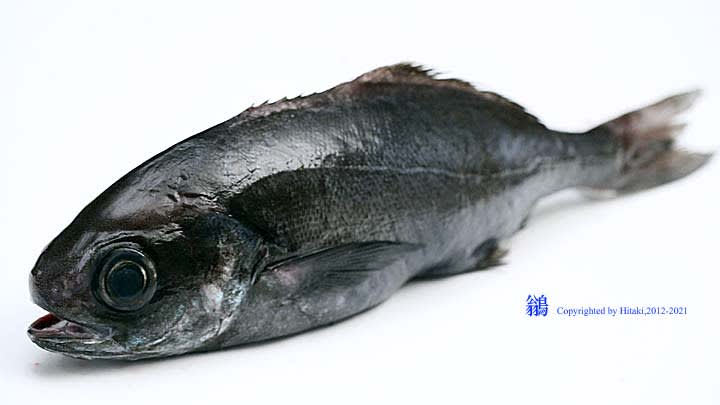
>medai, 目鯛, めだい, メダイ, "eye tai", Hyperoglyphe japonica

Continuing my tai (鯛) series. Akodai (赤魚鯛), ishidai (石鯛), kinmedai (金目鯛), madai (真鯛), amadai (甘鯛), kurodai (黒鯛) and, of course, our international star, matodai (的鯛/馬頭鯛). Also, don't forget taimeshi (鯛飯), and taiyaki (鯛焼).

Today's special fish is medai, 目鯛, "eye tai," our kinmedai's plain cousin?

me (目) + tai (鯛) = medai

Medai,
Hyperoglyphe japonica, may be tired-looking (he just naturally looks beat up), but never underestimate him. No one has to know he is ugly when he appears all cleaned and freshened up on dinner plates. He manages to appear in top-notch restaurant meals, thank you very much.

Finding him on the menu may not be so easy. Japanese butterfish? Pacific barrelfish? Simply medai?

If you do find him, he could very well become your new favorite fish. Remember the eye, 目.

2010-03-10

>black watermelon, 黒西瓜, 黒すいか, 黒スイカ, 黒い西瓜, 黒いすいか, 黒いスイカ


You say black watermelon, some say expensive.

Black is indeed beautiful. Just ask a ganguro. (ガングロ, black face girl, popular makeup/beauty culture phenomenon.)

Once upon a time, black watermelons hailing from Hokkaido called でんすけすいか, Densuke, fetched thousands of dollars at auctions.

That was during the boom times, and people don't seem to care too much anymore.
But in any case, the fruit is interesting. It goes by 黒西瓜, 黒すいか, 黒スイカ, 黒い西瓜, 黒いすいか, 黒いスイカ, 黒い西瓜 (all variants of kuro suika or kuroi suika, all meaning "black watermelon".

Some have called it 黒丸 (kuromaru, black ball). Yes.

Yes, PRETTY.

2010-03-03

>ひな祭りおめでとう Happy Doll Festival Day

Doll Festival, Girls' Day, Hina Matsuri (ひな祭り = "chick worship"/"chick festival"). An excuse to eat cute little colorful snacks. Depending on the region, you drink 白酒 shirozake (white sake) and eat 生菓子 namagashi (soft, moist wagashi 和菓子 cake), 引千切 (hichigiri, pointy-shaped mochi), 菱餅 hishimochi (colorful, usually pink and green, diamond cake), 雛あられ hinaarare (tiny "chick" crackers). 鯛や蛤の料理 bream (tai) or clam (hamaguri) dish (especially as 吸い物, suimono, clear soup), ちらし寿司 chirashizushi (chirashi sushi). Happy Dolly Day.