>>Grocery Trekker by Sharon Hahn Darlin Blog archive at the bottom of the page.
For more haiku, please visit Language Gallery.

2006-12-28

>more herb mousses

It is no mystery that I am drawn to herb mousse.

Because mousse also means moss. If you've ever admired a beautiful moss-covered rock or tree bark on a rainy day you know what I mean.

My friend Ivy used to recite passages from Nancy Drew's Moss-Covered Mansion. I didn't really get Nancy Drew. I was into Sherlock Holmes.

Because the word mushroom also comes from mousse - a rationalization of sorts for the mostly inexplicable allure of both mushroom and mousse.

And because it's green. It can be red, too. Sorry I didn't strictly limit the list to herbs.
Happy belated Christmas, everyone.

***

-Skewers of scallops and Spanish ham with parsley mousse, zucchini, and passion vinaigrette - Sol e Luna Restaurant, Grand Case, St. Martin
-Grilled lamb fillet with savory herb marinade, habichuela blanca mousse - Casa Havana, Grand Cayman, Cayman Islands
-Mild smoked salmon served with salad, horseradish mousse and deep-fried sage - Parkhotel Gunten, Switzerland
-Artichoke puree, fingerling potatoes, braised shallots, spinach, red pepper mousse - The Gables at Chadds Ford, Pennsylvania
-Sformati di Bietole (swiss chard mousse charlotte, grated parmesan) - Rustico, Sausalito, California

2006-12-27

>herb mousse

We had one of those sweet mom and daughter dinners I love so much at Mansion on Turtle Creek, one of the most beautiful restaurants in the country. Mom admired the basil mousse that came with our amuse bouche.

When the main course arrived, she sheepishly stared at her "burned" steak.

"Mom, that's NOT burned. That's how they do it in Dallas."
Embarrassed silence.
Mom is so polite, she hates sending dishes back to the kitchen. So she started carving. One thing she hates more than sending dishes back is charred steak that is still rare inside. I would have eaten it myself (yum!) but it's against my principle to pay so much for a piece of steak. She apologized and sent it back. They comped it! So nice of them.

***
I looked up the herb mousse action happening around the world. For some reason, I've found the "mousse" on English menus denser than the more airy "foam". Foam is getting tired, mousse has a good chance, I guess.

Tuna carpaccio with beluga caviar, fennel mousse and salad - Restaurant l'Europe, St. Petersburg, Russia
Sea bass with a scallop and lemon balm mousse - The President's Restaurant, Mallow, County Cork, Ireland
Chocolate and lavender mousse - KN Restaurant, Tallinn, Estonia
Chicken breast stuffed with rabbit and tarragon mousse - Antibo restaurant, Sheffield, England
Roasted breast of cornfed chicken stuffed with oregano mousse on sweetcorn - Temple Sowerby House, Penrith, Cumbria, England
Tomato salad with buffalo milk mozzarella and basil mousse - Hotel Zum Storchen, Zurich, Switzerland


2006-12-26

>milk caramel and dulce de leche

You can overthink dulce de leche.

Like any other sweet treats, it can be presented in many different ways, and there are differences in the quality of ingredients used, but I don't understand the perceived mystery behind this rather mundane caramel.

Of course, it is tastier than plain caramel since the amino acids in milk cause Maillard reactions and result in more complex flavors.

Insistence on having to cook a can of sweet condensed milk unopened, for instance. What the? For convenience? If it is excitement you are after, I suggest you get it somewhere else.

Let's say you are craving dulce de leche right now, and you happen to have a can of sweet condensed milk. You can make it in a few minutes.

1) Use a cast iron frying pan.
2) Mix about half a cup of water with half a can (7 oz) of condensed milk.
3) Stir as you cook this mixture, and control the heat so it doesn't bubble over.
4) When it turns tan or brown, turn the heat off a little before it reaches your desired shade of color.

Water initially prevents the mixture from burning and gives the flavor a chance to develop. Caramelization generates extra heat, so it is important to turn the heat off before you think it's done. Milk is remarkably stable when heated to high temperatures, so you don't have to worry about much at all, except not to burn the whole thing.

When done, spoon it into a little pyrex cup or a ramekin. If it cools and hardens, you can microwave it for about 10 seconds to soften it.

2006-12-24

>sugar vs. fruit sugar

I saw a packet of fructose being sold in the supermarket, and I had to stop myself.

Since

1) fructose is easy to process into crystals or syrups and
2) it is the sweetest of all the sugars and relatively cheap,

...why don't I see more of it?


(1 glucose molecule + 1 fructose molecule = 1 sucrose molecule, so 1 common sugar molecule is twice as big as a fructose molecule.)

Fructose is the sugar in fruits and honey, and processed fruit drinks also have plenty of it. It would actually be handy to have at home to make cold drinks like lemonades. Compared to table sugar, it dissolves much more easily, and only half would be needed (half the calories!) to sweeten the same amount. It however loses a lot of sweetness at high temperatures.

Sucrose is most versatile in the kitchen since we need to use it in hot drinks, candies, cakes and cookies.

Too much sugar, any sugar, is never a good idea, but it's always good to have an option.

2006-12-19

>fruit vinegar egg scramble

One of the most pronounced trends in the world's best restaurants has been the movement toward lighter, herbier sauces using more fruit and vegetable reductions, in place of heavy meat and cream based sauces.

It is interesting to ponder if similar trends are invading the breakfast territory. ("cream-based vs. fruit-based"...)

Whatever the case may be, consider the following delicious surprise. This is absolutely the creamiest scrambled eggs you've ever had. The astonishing fact is that it has no cream in it.

For all we know, they have been cooking eggs with vinegar for probably thousands of years in the Middle East.

Ingredients:

Eggs (5-6)
Fruit vinegar (1 tbs)
Water (3 tbs)
Salt (a pinch)
A little bit of nut oil/gingelly oil/butter/olive oil or none at all
Black pepper

Beat the eggs with salt, vinegar and water, just until well blended.
Heat oil in a non-stick pan. Pour the egg mixture and cook it -p-a-t-i-e-n-t-l-y- in low heat.
Scrape the pan gently and often to cook the mixture evenly.
Remove it from heat still underdone as it will continue to set.

Sprinkle pepper and try it.

What do you think?

>tea rub vs. oil rub

Pioneering chef Daniel Patterson is currently in love with tea, and he puts it to good use in a number of appealing dishes. Ming Tsai is the original fan of tea rub.

A word of caution on tea rub:
While tea is an exciting flavoring agent for meat smoking and marinating, it makes less than ideal coating when subject to direct heat.

Tea leaves tend to burn quickly so it's only suitable for quick searing. Unless you are prepared for some post-grill scraping, try instead oil-rich ground sesame seed, pistachio, poppy seed or flaxseed when preparing a dry rub. The flavors of cracked spices you add to the rub dissolve in the oil and withstand the heat longer, and a
n appropriate amount of salt in the rub helps the meat surface to retain moisture.

A dry rub which stays on provides an insulation buffer for direct heat, and prevents the meat itself from drying out. In addition, the seeds mentioned above turn into crispy crust, adding a crunchy, edible, texture element to accompany the tender meat inside.

2006-12-13

>popcorn vs. popamaranth


Why do we pop corn?

Because popcorn is crunchy.
Because we can eat it for hours and don't fill up.
Because we can.

Yes, because we can.

Can we pop other seeds?

We can, and we do. Protein-rich pearl millet is an even better choice for popping. So is amaranth. Popped kernel size is smaller, but if we didn't have such a corn glut situation in this country, perhaps coming to a theater near you could be buttered popmillet and popamaranth.

2006-12-11

>twice cooked pork

Some cooks really knew what they were doing.

They long ago figured out the best scientific method possible for cooking a chunk of meat.

The reasons Chinese (Sichuan) twice cooked pork, hui guo rou, makes so much sense;

1) The most tender meat results from being cooked (see Hainanese chicken) in water (ideal temperature as low as 160F - 180F) for effective heat transfer and to prevent drying out. The meat has to stop cooking at the point when the center is barely cooked through, still slightly pink, which takes a lot less time than you think - matter of minutes, not hours. We are not making English boiled pork here.

2) What's missing here is the flavor we like so much when we normally grill or sear the meat - the surface browning ("Maillard reaction") and caramelization. So the Chinese chopped up the barely cooked, juicy, tender, easy-to-cut meat into matchstick strips, covered them with marinade, and gave the now enormous total surface area a brief but intense hot wok searing action.

Whatever seasoning you add to enhance the dish seems only incidental.

Ingenious.

2006-12-10

>wine jelly vs. vodka jelly

Can you gel wine?

Port wine jelly, pinot noir wine jelly, viognier wine jelly. Yummy sounding, but what you find most often in stores are wine-flavored non-alcoholic jellies.

Kiddie-friendly spreads are not the kinds we are really interested in, are they.

Wine jellies should be relatively simple to make. Why non-alcoholic?


A misconception:
Alcohol keeps the wine from gelling. Not true. This is not about freezing the alcohol. Ever tried vodka jelly? We know that alcohol actually increases gel strength.

Wine is an alcohol, yes, a relatively weak one, and it's an acidic drink, a good candidate for a pectin jelly, if it weren't so watery.

In an attempt to create a more dense mixture by evaporating the water (aren't we going up to over 200F), unfortunately the alcohol is boiled away first (about 173F under standard atmospheric conditions).

Darn it.

2006-12-08

>secret of the Hainanese chicken rice

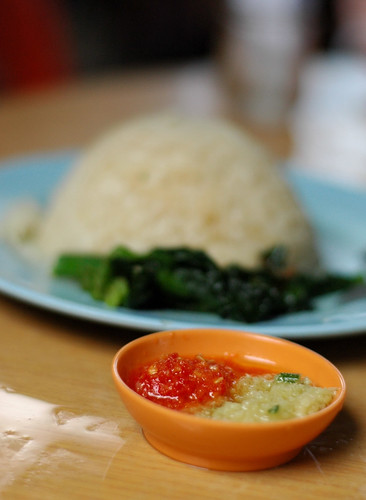
First, here's the outline of the ***secret*** recipe of the proper Singaporean Hainanese chicken rice.

Bring a big pot of chicken stock to a boil. (~212F) Don't add any salt or seasoning. Turn off the heat, lay a 3-pound whole chicken (or just chicken breast if you want) in the stock, and cover the pan. After about 15 minutes (or until the stock cools to about 130F) plunge the chicken in ice bath to stop cooking it. Bring the stock back (close) to boil, while the chicken sits and waits. Repeat the process for a total of about 40 minutes steeping time (there IS a mathematical formula for each different volume or thickness - a fascinating topic.)

Cut it up, Enjoy with chili ginger sauce, cucumbers, rice cooked in chicken stock, and a simply seasoned broth made with the remaining stock.

Q: The temperature seems awfully low, considering we bring it up to something like 375F for oven roasting.

A: Once the chicken is exposed to the initially boiling water, the surface bacteria are destroyed.
Then it is cooked at an average of 180F, which is exactly the internal temperature we want to achieve (check your meat thermometer). It could be a lot lower, but overcompensate so you don't scare cautious American cooks.

Q: Steeping it below boiling temperature does sound dangerous. Will it cook through in 40 minutes at only half the temperature of oven roasting?

A: You are basically equalizing the water temperature and the meat temperature. Water is a much more effective heat transmitter as opposed to hot oven air - many many more molecules at work in a dense medium.
If you happen to have a cooker that can keep the water temperature constant at 140F - 180F, that'll do, too, but make sure you kill the bacteria.

Q: Why does it taste better?

A: The ideal texture of some meat, poultry or fish is achieved by cooking it at around 140F within the ideal cooking time window (when it's just cooked through). Overcooked chicken is just about the worst thing, yet most people are used to it.
Adding salt to the broth raises the boiling temperature, and that's not ideal. Boiling temperature of water is just a marker, like a $100 bill. It doesn't mean anything to the chicken!

image from taken by pat2bach at Chatterbox, hotel Meritus Mandarin, Singapore

Q and A by Sharon Hahn Darlin

2006-12-07

>umeboshi vs. hua mei

Today I read parts of Harold McGee's On Food and Cooking - The Science and Lore of the Kitchen. This clear, comprehensive book answers so many questions I have.

It is so comprehensive, in fact, that it's going to influence the way I blog. Before I do an entry, I'll check this book to see what I am about to say is not already mentioned in a similar way...

...which will be a formidable challenge. To me, the allure of something seems to be the unknown, and it's no fun blogging about something already mentioned by a book.

So today's entry involves questions about something I couldn't get a satisfactory explanation for.
Intense tartness or sourness enjoyed by some people.

The Asian apricot (Prunus mume) is preserved dry in China and called huamei. It is pickled in Japan and called umeboshi. Both kinds are heavily salted and enjoyed for their extreme sour quality. So sour in fact, that just the thought of eating them makes you salivate.

So widely consumed, I thought it might be included on the pickled vegetables and fruits table. It wasn't, so here's my small contribution.


>transparent cooked egg

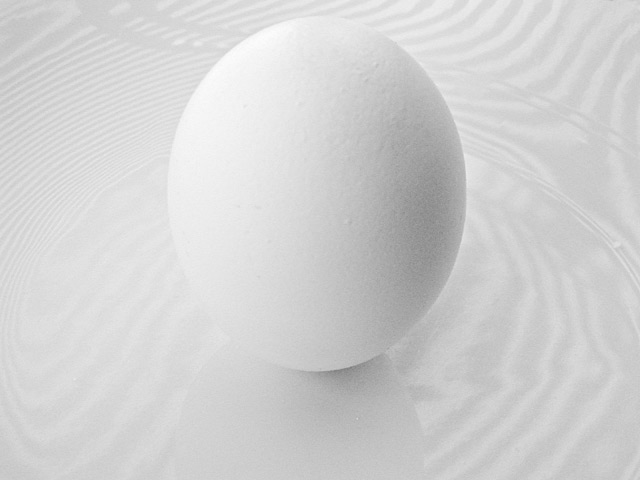
When we cook the clear egg white, we all know what happens. Can you imagine a transparent cooked egg white? Apparently it's all about the pH and temperature.

In a nutshell, in an eggshell in this case, the recipe is this. Chefs would marinate the eggs in a special alkaline solution made with salt and wood ash for 8 days. Then it's cooked in very low heat (160F/70C) for 10 minutes. The eggs set to a golden yolk and transparent, colorless white.

Abracadabra.

2006-12-06

>cheese custard vs. durian

You have to be brave to experience durian. If you do it wrong the first time, you'll probably not be back for a long time, if ever.

If you do it right, you'll eventually hope that people keep avoiding it so the price stays low. Addicts must be spreading the bad rap, since in Southeast Asia, what you hear more often is "I'd sell my parents so I can afford durian."

Here's how you do durian, unless you are a true gourmand who gets it the first time. Step by step.

1) Get mentally ready. While it IS a fruit, do not expect it to taste like fruit - expect creamy, sophisticated, cheesy sweet custard.


2) Start with a popular durian drink, sold at boba or bubble tea stores. In San Francisco, there is only one chain I like (4 stores owned by the same family in the area), and that is Sweetheart Cafe, which uses real fruit. Ask for "durian smoothie with pearls", one of their best sellers.

3) Move onto frozen durian. Little odor, just savory.

4) Time to crack a real durian - start with a Thai durian. Serve it on a plate seedless with a spoon or a fork, and don't eat it with your finger, for God's sake.

5) If you tolerated it so far you can graduate to the ripe Penang durian. Cook something meaty (mutton curry) before you cut up the fruit.

Durian makes a good dessert paired with a syrupy Sauternes, something resembling a Chateau d'Yquem. I was curious about this wine and tried it years ago at a wonderful little restaurant Hiramatsu on Ile Saint Louis in Paris (I forget the vintage - bye bye all the francs we had). Good, but definitely overhyped.

>macadamia nut vs. candlenut

When I see children tethered to their parents' car, I cannot help but feel lucky for the relative freedom I enjoyed as a kid in Singapore, being allowed to navigate my way around the city on my own. The question "is it safe?" would have raised eyebrows. Safe from what?

I absolutely believe that exposing children to the stimulating city life gives them more. More of anything and everything.

It was certainly nice to get a ride home from school in mom's car (she drove a Mercedes-Benz...), but I like
d the option of walking and public transportation, especially when visiting friends.

Snacking on the street wasn't exactly encouraged, but t
he occasional satay tasted so good!

One of the ingredients which makes satay extra good, in addition to peanuts, is candlenuts which look a bit like macadamia nuts. These creamy nuts are not eaten raw, but ground and cooked. There are some wild legends about this nut all over Polynesia, and it is Hawaii's state tree, kukui.

If you happen to be lost in the wilderness with these nuts, it'd be a snap to start a fire. Something to remember when you go camping.

2006-12-05

>sesame oil vs. gingelly oil

Mystery of the golden oil - solved.

This is another story from Singapore. I would play badminton and swim with friends at a private club near Yaohan.

There was a food stall where a Tamil man would pour his oil ceremoniously onto his mutton pan, the thin stream of honey-colored oil looking momentarily, mesmerisingly, solid. On the bottle was written "sesame oil" and I thought it didn't look anything like the sesame oil we had at home.

It is the fragrant gingelly oil, made from unroasted sesame seeds. It's used for making fruit pickles, murukku cookies, and in religious ritualistic oil baths - just a few drops.

>chilli ginger sauce

Our amah in Singapore was a sweet, gentle woman, not a particularly memorable cook. Because she was from Hainan, I would try to ask her about Hainan chicken rice back home, which was, I heard, different from Singaporean Hainanese chicken rice. I remember her smiling and continuing on with her chores. I never learned her language.

The Hainan, or Hainanese, chicken rice is one of my favorite dishes. The one I remember most fondly,
the most delicate chicken dish you'll ever encounter, was from a hawker stall in Marine Parade.
The recipe sounds deceptively simple, although the best one I know involves plunging the bird in ice bath in between steeping sessions.It also requires the perfect chili ginger sauce. Small red chilies, sometimes called cili padi (not "silly putty" - in Malaysian, c is pronounced ch), garlic, ginger, vinegar, sugar and salt.

2006-12-04

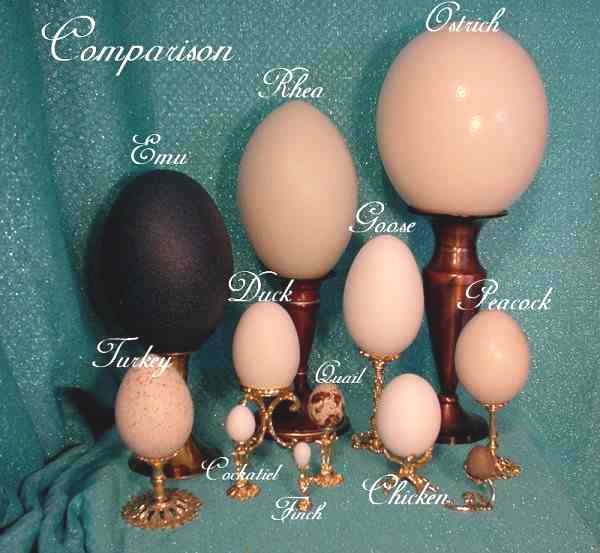
>wild goose egg

The city of Oakland suffers a big headache when it comes to Canadians. They enter the country and refuse to leave.

Canada geese, that is. Having forgotten that they are migrating fowls, they live all-year-round on Lake Merritt. What's the big deal? The answer is um, privy.

Here is such a sensible idea I am not sure Oakland has tried it yet. When in doubt, do what the Eskimos do. Hunt the eggs down.

Let children loose around the park on Easter (or whenever the egg laying season is) and offer some serious prize for the yummy eggs, before they hatch into super adorable goslings.

I don't recall trying goose eggs, but I am told they are very tasty indeed. As for the numerous birds themselves? I live in Berkeley, so I cannot contemplate what a kid at an Austin County Fair suggests we do.


2006-12-02

>wagyu vs. fatback

Status food.

If we order something precisely because it is more expensive, it fits in this category. The current ultimate expense account lunch, well-marbled wagyu (gaigyu??) is most definitely overrated, and most certainly a status food.

Because we tend to deprive ourselves of fatty cuts at home, premium fatty meat tastes even better at restaurants, so we gratefully pay through the nose for the chance to indulge. Granted, wagyu certainly tastes good, but so does a Shake Shack burger.

Since we'd have to be unafraid of saturated fat eating wagyu, let's go all out and feast on
premium quality pork fat which seldom sees the restaurant light of day in this country.

If you can't stomach anything called pork fat on the menu, the restaurant will happily disguise it for you. Speck, slanina, salo. Lardon?

2006-12-01

>chicken stock vs. kelp stock

Unfortunately, some foods sound only vaguely edible instead of conjuring up warm memories of grandma's kitchen. Let's try.

Chicken stock.
Kelp.

One of them brings to mind bottles of infomercial iodine supplements, barley grass or alfalfa powder. Or cool underwater forest scuba diving, but not exactly food per se.

Actually, kelp -minus its flavor- is a widely used secret ingredient in commercially processed desserts, dairy products, beer foam, salad dressings, baked and frozen goods.

Natural kelp makes an excellent base if you want your soup to smell like the ocean. The kelp broth tastes surprisingly rich by itself without added beef, fish or chicken bones. Just add lots of onions and garlic, perhaps some clams if you find the stock weak, plus a featured main item (fish fillet is nice) and your favorite spices.

Starving contestants on CBS show Survivor are unlikely to encounter kelp forests which thrive in cold water, but they should study up on edible seaweed. There is, by the way, an inherent problem with the English word seaWEED, isn't there.

You may find relatively fresh kelp in the refrigerated section, either vacuum-packed or slightly salted, and there are several kinds of dried kelp. Dashi is not pure kelp stock, but you can easily find it in plastic bottles and Capri-Sun style packs.
There are also many different brands of artificial-tasting dashi powder, which taste awful if you use too much.

Whenever I see stacks of canned chicken stock, I can't help imagining stacks of cheap canned kelp stock. Who knows?